What Happens When AI Becomes Capable Enough to Participate in the Real World?
For years, AI lived mostly inside a screen. You typed a question, it generated an answer, and you asked it to write something—it wrote it.
That was already impressive.
But we’re entering a different phase.
AI is increasingly being connected to tools, software, websites, databases, cameras, devices, robots, and real-world systems. Instead of simply telling us what to do, AI can increasingly help do things.
And that changes the question.
“What happens when AI becomes capable enough to participate in the real world?”
From Answering Questions to Taking Action
A traditional chatbot waits for instructions.
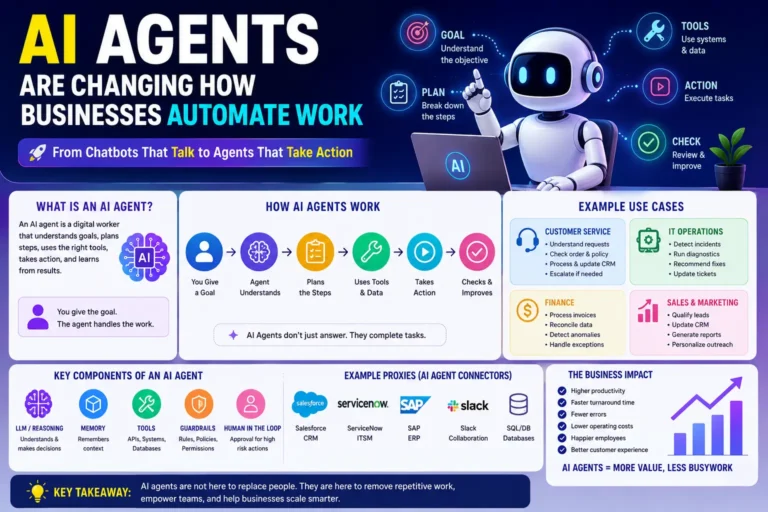
An AI agent can potentially take a series of actions to achieve a goal.
For example, instead of asking:
“How do I research competitors?”
you could eventually tell an AI:
“Research my competitors, compare their products, identify opportunities and prepare a report.”
The difference sounds small, but technologically it’s enormous.
The AI needs to understand the objective, decide what information it needs, use different tools, evaluate what it finds and produce a useful result.
The more autonomy we give it, the more useful it becomes.
But there’s a catch.
The AI can also make mistakes without waiting for a human to catch them.
The Biggest Opportunity May Be Outside the Technology Industry
It’s easy to think AI is mainly about chatbots and coding.
It isn’t.
Imagine AI systems helping researchers analyze scientific literature, assisting doctors in finding possible diagnostic leads, helping engineers investigate complicated failures or helping teachers adapt learning materials to individual students.
The value comes from reducing the amount of time people spend on repetitive information work.
Humans still make the important decisions.
AI becomes the system helping them get there faster.
That could be one of the most positive changes AI brings.
But Autonomy Changes the Risk
There’s a major difference between an AI giving you bad advice and an AI acting on bad advice.
If a chatbot gives you an incorrect answer, you can ignore it.
If an autonomous system sends the wrong email, changes the wrong setting, publishes incorrect information or interacts with another system without permission, the consequences can be very different.
This is why AI safety isn’t simply about making models smarter.
It’s also about deciding:
- What can an AI access?
- What can it change?
- What requires human approval?
- How do we know what it did?
- Can we stop it quickly?
- Who is responsible when something goes wrong?
These questions will become increasingly important as AI moves from conversation to action.
Trust Will Become More Important Than Intelligence
There’s an interesting paradox here.
The smarter AI becomes, the more we may want to rely on it.
But the more we rely on it, the more important trust becomes.
Would you allow an AI to manage your calendar?
Probably.
Your emails?
Maybe.
Your company’s finances?
That’s a different conversation.
A hospital’s systems?
Now the consequences become much bigger.
The future of AI won’t be determined only by what these systems can do.
It will also depend on what people are willing to let them do.
The Workplace Will Change Quietly
The biggest impact may not arrive as a dramatic moment when robots suddenly replace everyone.
It could happen much more quietly.
One person using AI may be able to research faster.
Another may automate reports.
A developer may use AI to investigate problems.
A marketing team may produce and test more content.
A customer-support team may automate routine conversations.
Over time, companies may redesign entire workflows around AI.
That means the important skill may not be simply knowing how to use AI.
It may be knowing which work should be given to AI—and which work should remain human.
AI Will Enter the Physical World Too
Software is only the beginning.
As AI connects with cameras, sensors, machines and robots, it can begin interacting with the physical environment.
That’s where things get particularly interesting.
A robot doesn’t just generate text.
It can potentially see a room, understand an instruction and physically interact with objects.
That creates enormous possibilities in manufacturing, logistics, healthcare, agriculture and other industries.
It also creates a much higher standard for reliability.
A spelling mistake in a chatbot is annoying.
A mistake made by a machine operating in the physical world can be much more serious.
So, Should We Be Excited or Worried?
Honestly?
Both.
AI could help people solve problems that currently take enormous amounts of time and expertise.
It could accelerate research, improve productivity and make sophisticated tools available to people who couldn’t previously afford them.
But the same capabilities can create new problems.
More powerful AI can also mean more convincing scams, more sophisticated attacks, greater privacy concerns and systems that can cause problems at a scale humans aren’t prepared for.
The answer isn’t to stop AI from becoming capable.
It’s to make sure capability grows alongside control, transparency and responsibility.
The Real AI Race Has Changed
The early AI race was largely about one question:
“Who can build the smartest model?”
The next phase may be different.
It could be about:
“Who can build the most useful AI system—and make it reliable enough to trust?”
That means models matter.
But so do the tools around them, the safeguards, the people supervising them and the environments in which they’re deployed.
The future probably won’t belong to AI that simply knows everything.
It will belong to AI that can understand a goal, use the right tools, take useful actions and know when to stop and ask a human.
What Happens When AI Enters the Real World?
Maybe the biggest change won’t be that machines become more human.
Maybe it will be that humans start working differently because intelligent machines are finally capable of working alongside them.
And that’s why one question is becoming increasingly important:
What happens when AI becomes capable enough to participate in the real world?