AI Agents Are Becoming Digital Workers in 2026
AI Agents Are Becoming Digital Workers in 2026: How Agentic AI Is Changing the Future of Work
AI agents are moving beyond chat. In 2026, artificial intelligence is increasingly being connected to business systems, software tools and real workflows, allowing AI systems to perform tasks rather than simply answer questions.
This shift is creating a new category of software increasingly described as the AI digital worker.
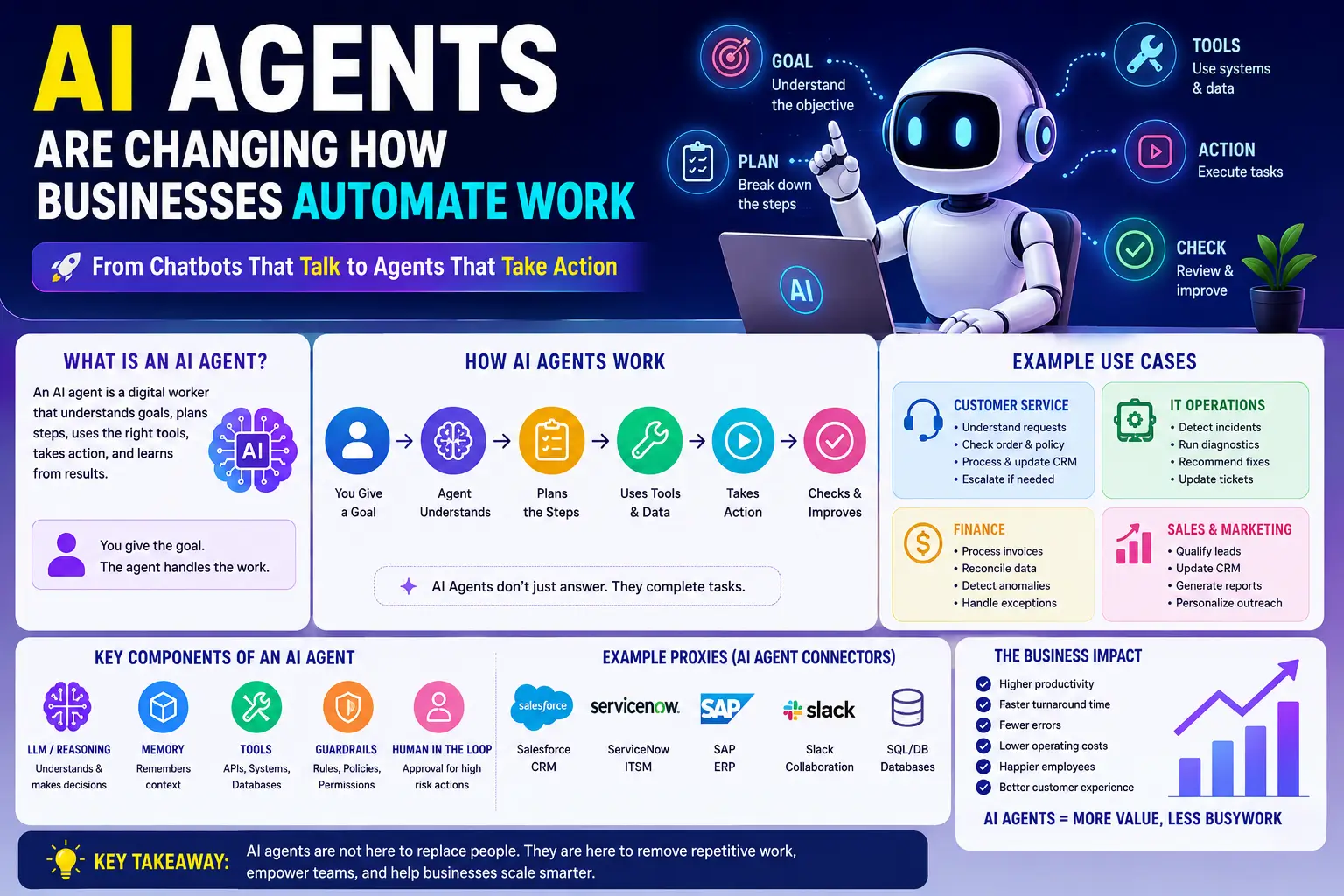
Unlike a traditional chatbot, an AI agent can potentially understand a goal, break it into steps, retrieve information, use approved tools, interact with software and complete parts of a workflow with varying levels of human supervision.
The important change is simple:
AI is moving from generating information toward performing digital work.
Key Takeaways
- AI agents are moving from simple assistance toward delegated, multi-step work.
- AI digital workers can combine AI models, business data, APIs and enterprise applications.
- Human approval remains important for sensitive, high-impact or irreversible actions.
- The near-term impact of AI is likely to involve significant task transformation, not simply entire-job replacement.
- Security, permissions, monitoring and governance are essential when AI agents interact with enterprise systems.
- The future of work is increasingly likely to involve humans working alongside specialized AI agents.
What Is an AI Digital Worker?
An AI digital worker is an AI-powered software system designed to perform a defined category of digital work.
It can combine:
- AI models
- Business instructions
- Company knowledge
- Enterprise data
- APIs and software tools
- Workflow rules
- Identity and permissions
- Monitoring and logging
- Human approval
Consider the difference.
Traditional chatbot: “How can I troubleshoot this Microsoft Teams problem?”
AI digital worker: “Investigate this Teams support request, gather the relevant information, identify the likely cause, recommend the next action, obtain approval when required, perform the permitted action, verify the result and update the ticket.”
The distinction is therefore not simply whether AI can produce an answer.
It is whether AI can participate in a complete workflow designed around an outcome.
AI Chatbot vs AI Assistant vs AI Agent vs Digital Worker
These terms are related, but they describe different levels of AI involvement in work.
| Technology | Primary Role | Example |
|---|---|---|
| AI Chatbot | Answers questions | Explains a technical concept |
| AI Assistant | Helps a person work | Drafts an email or summarizes a meeting |
| AI Agent | Performs multi-step tasks | Researches an issue and prepares a result |
| AI Digital Worker | Performs a defined category of business work | Handles a repeatable IT support workflow |
| Multi-Agent System | Coordinates specialized agents | Research → Analysis → Execution → Verification |
The boundaries between these categories are not rigid. An AI assistant can include agentic capabilities, while a digital worker can combine AI agents with traditional automation.
The larger transition is from answering toward delegated execution.
Why Are AI Agents Becoming Digital Workers in 2026?
1. AI Agents Can Use Tools
Modern AI agents can potentially interact with software instead of simply generating text.
Depending on their architecture and permissions, agents can work with:
- APIs
- Databases
- Files
- Browsers
- Enterprise applications
- Cloud services
- Development environments
- Business systems
This makes AI more useful inside existing business processes.
2. AI Agents Can Handle Multi-Step Work
A traditional chatbot interaction may finish after one answer. An agent can potentially continue through several steps while using tools and checking intermediate results.
This creates a significant difference between:
“Tell me how to do this.”
and:
“Do the work required to achieve this outcome.”
3. Enterprise AI Is Moving Toward Execution
Enterprise AI adoption is increasingly moving beyond asking AI for assistance toward delegating substantive digital work.
OpenAI’s 2026 enterprise research describes growing use of AI for longer-horizon work across multiple knowledge-work functions, while Google Cloud describes organizations moving toward AI agents capable of orchestrating complex business processes.
Sources:
- OpenAI: How AI Agents Are Transforming Work
- OpenAI: Enterprise AI Data
- Google Cloud: Building the Agentic Enterprise
Real-World Scenario: An AI Digital Worker in Enterprise IT
Imagine an employee submits this request:
“I cannot access a Microsoft Teams resource.”
A traditional chatbot might show a troubleshooting article.
An AI digital worker could potentially coordinate a larger workflow.
Step 1: Employee Raises the Request
The employee submits the issue through a service portal.
Step 2: Agent Understands the Problem
The agent identifies the issue category and gathers the information it is permitted to access.
Step 3: Agent Investigates
The agent can potentially examine approved knowledge sources, service information, diagnostic information and previous incidents.
Step 4: Agent Identifies a Likely Cause
The agent compares available information against known troubleshooting and resolution paths.
Step 5: Human Approval
If the proposed action could affect a production system, sensitive information or another important resource, the workflow can require approval from an authorized person.
Step 6: Agent Executes the Approved Action
The agent performs only the operation it has been authorized to perform.
Step 7: Agent Verifies the Result
The agent checks whether the requested outcome was achieved.
Step 8: Ticket and Audit Record Are Updated
The workflow is documented so the organization can understand what happened.
The important point: the AI is not necessarily replacing the IT department. It is taking responsibility for selected repeatable steps inside an existing workflow.
How an AI Digital Worker Works
A simplified enterprise workflow looks like this:
Employee Request → AI Agent → Business Context → Enterprise Tools → Approval → Action → Verification → Audit
The AI model itself is only one component.
A production digital worker also needs:
- Reliable information
- Identity
- Access control
- Business rules
- Monitoring
- Error handling
- Human escalation
- Auditability
Where AI Digital Workers Can Add Value
Customer Support
- Classifying incoming requests
- Searching knowledge bases
- Retrieving customer information
- Drafting responses
- Updating CRM records
- Escalating unusual cases
IT Operations
- Incident classification
- Log analysis
- Troubleshooting
- Knowledge retrieval
- Ticket updates
- Documentation
- Routine diagnostics
Software Development
- Code generation
- Debugging
- Testing
- Documentation
- Codebase analysis
- Issue investigation
Sales and CRM
- Account research
- Lead research
- CRM updates
- Meeting preparation
- Follow-up drafting
Human Resources
- Interview scheduling
- Policy retrieval
- Employee questions
- Onboarding support
- Document preparation
Finance
- Invoice processing
- Data reconciliation
- Report preparation
- Document classification
- Exception detection
AI Agents and Microsoft Teams
Enterprise communication platforms are another important environment for AI-assisted workflows.
Depending on the organization’s architecture, AI agents could assist with:
- Meeting preparation
- Meeting summaries
- Action-item tracking
- Knowledge retrieval
- User support
- Ticket creation
- Follow-up workflows
- Internal knowledge searches
For organizations using Microsoft Teams together with Microsoft 365, Exchange, identity systems, service-management platforms and other enterprise applications, the larger opportunity is connecting these systems into controlled workflows.
The real enterprise question is not “Can AI do this?”
It is “Which parts of this workflow can AI safely perform?”
AI Digital Workers vs Human Employees
| Area | AI Digital Worker | Human Employee |
|---|---|---|
| Speed | Very fast for defined digital tasks | Varies |
| Scale | Can handle many digital tasks | Limited by human capacity |
| Availability | Can operate continuously | Human working schedules |
| Consistency | Strong for defined workflows | Can vary |
| Judgment | Depends on model, data, instructions and controls | Human experience and judgment |
| Relationships | Limited | Strong human interaction |
| Ambiguity | Can struggle with unclear situations | Better suited to complex context |
| Accountability | Requires organizational governance | Human responsibility |
Will AI Agents Replace Human Workers?
This is one of the biggest questions surrounding digital workers.
However, a job is usually not one task. It is a collection of many tasks.
Consider an IT administrator. The role may include:
- Reading logs
- Investigating incidents
- Writing documentation
- Communicating with users
- Designing architecture
- Approving changes
- Performing routine operations
An AI agent may automate some of those activities without replacing the entire role.
This means one of the most important near-term effects of AI may be task transformation rather than complete job replacement.
Human responsibilities can increasingly move toward:
- Judgment
- Architecture
- Leadership
- Communication
- Governance
- Exception management
- Problem solving
- AI workflow design
The Rise of the AI Workflow Manager
If AI agents perform more execution, humans will increasingly need to manage those agents.
Human defines objective → AI plans → AI executes → AI reports → Human reviews → Workflow improves
This creates new responsibilities around:
- Agent instructions
- Data access
- Permissions
- Validation
- Monitoring
- Security
- Workflow optimization
Human-in-the-Loop vs Autonomous AI
| Level | Operating Model | Example |
|---|---|---|
| 1 | Human only | Employee performs every step |
| 2 | AI assistance | AI recommends an action |
| 3 | AI preparation | AI prepares work and waits for approval |
| 4 | Controlled autonomy | AI executes predefined low-risk actions |
| 5 | Higher autonomy | AI manages a larger workflow with defined controls |
A practical enterprise progression is:
Assist → Prepare → Approve → Automate → Scale
Why AI Agent Security Is Different
Traditional software generally follows predefined instructions. AI agents can interpret objectives and potentially determine which actions are needed.
That creates additional questions:
- What can the agent access?
- What can it change?
- Which actions require approval?
- How are actions logged?
- How is the agent authenticated?
- What happens when the agent makes a mistake?
- Can it access information unnecessarily?
- How can administrators stop or restrict it?
For enterprise deployments, agent identity, permissions, monitoring, auditability and approval controls are therefore critical parts of the architecture.
The Principle of Least Privilege Applies to AI Agents
A human employee normally receives access based on what their job requires. AI agents should be treated similarly.
The question should not be:
“What systems can we connect to this agent?”
Instead ask:
“What minimum access does this agent need to complete its assigned workflow?”
Example: Customer Support Agent
- CRM access
- Knowledge-base access
- Ticketing access
It Should Not Automatically Have
- Payroll access
- Unrestricted production access
- Global administrator permissions
- Unnecessary sensitive-data access
AI Agents vs Traditional Automation
Traditional automation remains extremely useful when a process is predictable.
Traditional automation: If condition A occurs → perform action B.
AI agents become more interesting when inputs are less structured, such as:
- Natural-language requests
- Documents
- Emails
- Logs
- Conversations
- Mixed business information
The likely enterprise architecture is not:
AI agents instead of automation.
It is:
AI agents + traditional automation + humans.
The Future Could Be Teams of AI Agents
The next step may not be one universal digital worker.
Organizations may instead use specialized agents.
Research Agent → Analysis Agent → Execution Agent → Verification Agent → Human Manager
Each agent can have a narrower responsibility. This can make complex workflows easier to control, monitor and improve.
Google Cloud’s vision of the agentic enterprise similarly focuses on AI agents working across business processes and collaborating with human experts.
Read Google Cloud’s analysis of the agentic enterprise
What Businesses Should Automate First
The best first workflow is rarely the most complicated one.
Good candidates are usually:
High volume + repetitive + digital + measurable + relatively low risk.
Good First Candidates
- Ticket classification
- Knowledge retrieval
- Meeting summaries
- Report preparation
- Document classification
- Routine research
- Data extraction
- Internal FAQ handling
Poor First Candidates
- Irreversible financial decisions
- High-risk production changes
- Sensitive employment decisions
- Unreviewed security actions
- Processes with poorly understood business rules
How to Build an AI Digital Worker
- Choose one workflow. Start with a measurable process.
- Map every step. Document inputs, decisions, systems, actions, approvals and outputs.
- Define the boundary. Specify exactly what the agent can and cannot do.
- Connect business context. Provide the information required for the workflow.
- Apply least privilege. Give the agent only the permissions it needs.
- Add human approval. Require review for sensitive or irreversible actions.
- Add logging. Record important actions and outcomes.
- Measure performance. Track accuracy, time saved, failures, intervention and cost.
- Improve before scaling. Expand only after the workflow demonstrates reliable performance.
What AI Digital Workers Will Not Solve
AI agents are powerful, but they do not automatically fix:
- Poor business processes
- Bad data
- Weak security
- Broken integrations
- Unclear ownership
- Missing governance
- Poor employee training
- Bad organizational design
If a business process is broken, putting an AI agent on top of it can simply create a faster broken process.
The better sequence is:
Understand the process → Improve the process → Automate the right parts → Measure the result.
What Is Happening With AI Agents in 2026?
2026 is increasingly becoming a period where organizations are moving from AI experimentation toward practical agentic workflows.
OpenAI’s enterprise research reports growing agentic usage across multiple knowledge-work functions, while Google Cloud describes the emergence of enterprises where AI agents increasingly participate in business processes.
These developments point to an important change:
The competitive advantage may increasingly come from how effectively organizations connect AI to data, tools, workflows and governance.
The Future of Work Is Human + AI Agents
The most useful question is not:
“Will AI replace humans?”
A better question is:
“What happens when every employee can delegate parts of their digital workload to AI agents?”
A software developer may work with coding agents.
An IT administrator may work with troubleshooting agents.
A salesperson may work with research agents.
A marketer may work with analytics agents.
A finance employee may work with reconciliation agents.
The employee remains responsible for objectives, judgment and accountability while AI increasingly handles selected execution tasks.
AI Agents Are Becoming Digital Workers — But They Are Not Human Employees
The phrase digital worker is useful because it describes a major change in how software can participate in work.
But an AI agent is still software.
It does not automatically possess:
- Human judgment
- Human relationships
- Organizational accountability
- Ethical responsibility
- Real-world experience
- Guaranteed factual accuracy
Organizations should therefore treat AI agents as software systems with delegated responsibilities, not unrestricted employees.
The Future of AI Digital Workers
| Stage | Model | What AI Does |
|---|---|---|
| 1 | Chat | Answers questions |
| 2 | Assistance | Helps employees |
| 3 | Delegation | Receives complete tasks |
| 4 | Automation | Executes defined workflows |
| 5 | Orchestration | Coordinates multiple agents and systems |
Organizations will move through these stages at different speeds depending on their technology, data quality, governance and risk tolerance.
Final Verdict
AI agents are becoming digital workers because they are moving beyond simple conversation and into goal-oriented execution.
The fundamental shift is:
Generating information → Acting on information.
But successful enterprise AI adoption will not come simply from choosing the most powerful AI model.
Organizations need:
- The right workflow
- Reliable business context
- Connected tools
- Least-privilege access
- Human oversight
- Strong governance
- Measurable outcomes
That leads to a more realistic vision of the future:
Human + AI Agents + Enterprise Systems.
The companies that learn how to combine these three effectively may gain an advantage in productivity, speed and scalability.
Frequently Asked Questions
What is an AI digital worker?
An AI digital worker is an AI-powered software system designed to perform defined digital tasks or business workflows using AI models, data, tools and enterprise applications.
Are AI agents and AI digital workers the same?
Not exactly. An AI agent is a system capable of pursuing tasks through multiple steps. A digital worker is a broader business concept describing an AI-enabled system assigned to perform a category of work.
What is agentic AI?
Agentic AI refers to AI systems that can pursue goals through multiple steps, use tools and interact with external systems rather than simply generating a single response.
Are AI agents fully autonomous?
No. Agent autonomy can vary. Enterprise systems can operate with human approval, restricted permissions, monitoring and predefined boundaries.
Will AI agents replace human employees?
AI agents are likely to automate some tasks and change many workflows. Whether an entire job disappears depends on the tasks involved, technology reliability, economics, regulation and organizational decisions.
What tasks are best suited to AI agents?
Digital, repetitive, high-volume, measurable and relatively easy-to-verify tasks are generally strong candidates for AI-agent assistance or automation.
What are the biggest risks of AI agents?
Important risks include incorrect actions, excessive permissions, data exposure, poor business context, weak governance, lack of auditability and over-reliance on AI-generated decisions.
What is the difference between AI agents and traditional automation?
Traditional automation generally follows predefined rules. AI agents can interpret less-structured inputs and determine multiple steps needed to pursue a goal.
Why are businesses interested in AI digital workers?
Businesses are interested because agents may reduce repetitive work, accelerate workflows, increase scalability and allow employees to focus more on higher-value activities.
What is the future of AI digital workers?
The likely direction is toward specialized AI agents working together across enterprise applications, with humans supervising objectives, permissions, governance and important decisions.
Sources and Further Reading
-
OpenAI — How AI Agents Are Transforming Work
-
OpenAI — Enterprise AI Data
-
Google Cloud — Building the Agentic Enterprise