AI Agents for Business Automation: How AI Is Changing Work
Short answer:
AI agents are changing business automation by moving beyond simple rule-based workflows. Instead of only following predefined instructions, AI agents can interpret goals, plan multiple steps, use connected tools, retrieve information and perform approved actions. This allows businesses to automate increasingly complex workflows across customer service, sales, IT, finance, HR and operations while keeping humans involved when important decisions require oversight.
For years, business automation followed a simple pattern: people defined the rules, software followed the rules, and humans handled anything unexpected.
AI agents are changing that model.
Instead of simply executing a predefined sequence, an AI agent can receive a goal, reason through multiple steps, use connected tools, retrieve information, perform actions and adjust its approach when circumstances change.
That makes AI agents fundamentally different from traditional chatbots and many rule-based automation systems.
In 2026, businesses are increasingly moving from AI experiments toward AI systems that participate in real workflows. Microsoft describes this transition as organizations building governed systems in which agents can execute longer-running work across areas such as support, finance, HR, software development and operations.
The important question is no longer simply:
“Can AI answer a question?”
It is becoming:
“Can AI safely complete the work behind the question?”
What Is an AI Agent?
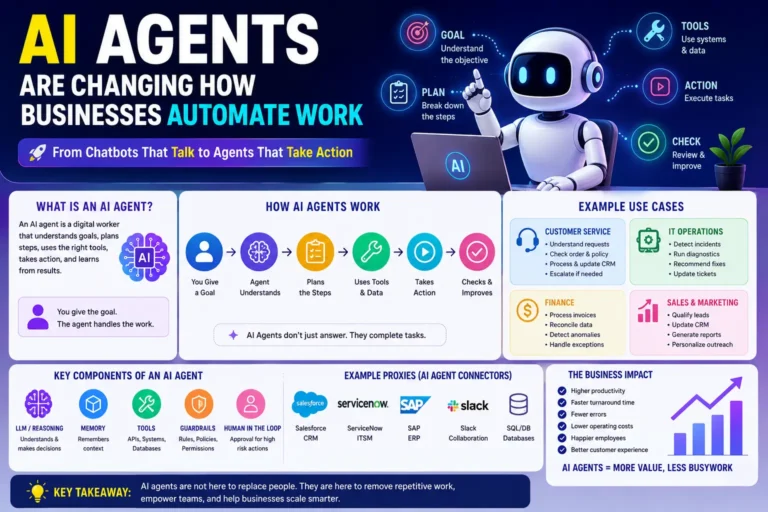
An AI agent is a software system that can pursue a defined objective by deciding what actions are needed and using available tools or systems to accomplish them.
A traditional chatbot might answer:
“What is the status of this customer order?”
An AI agent could potentially:
- Identify the customer.
- Retrieve the order.
- Check the payment status.
- Check inventory.
- Check shipping information.
- Determine whether there is a delay.
- Update the relevant system.
- Notify the customer or employee.
The exact capabilities depend on the agent, its permissions, connected systems and business rules.
This is why agentic AI is becoming particularly interesting for enterprise automation.
OpenAI describes agentic AI as moving knowledge work from individual interactions toward delegated, longer-horizon tasks in which agents can orchestrate tool calls and work toward a goal.
OpenAI: How agents are transforming work
AI Agents vs Traditional Automation
Traditional automation remains extremely useful.
For example:
This is predictable and rule-based.
But consider a more complicated situation:
An invoice does not match the purchase order. Determine why, check previous invoices from the supplier, identify the responsible department, gather supporting information and prepare the case for human approval.
This type of workflow contains ambiguity.
An AI agent can potentially reason through the available information and determine which steps should happen next.
Traditional automation
Trigger → Rule → Action
AI-agent automation
Goal → Reason → Plan → Use Tools → Evaluate → Act → Escalate
That does not mean AI agents should replace every traditional automation.
In fact, the strongest enterprise architectures will often combine both.
Use deterministic automation where the rules are clear.
Use AI agents where the work requires interpretation, planning or adaptation.
How AI Agents Automate Business Work
An AI agent typically operates as part of a larger system.
↓
AI Agent
↓
Reasoning / Planning
↓
Business Context
↓
Tools & APIs
↓
Business Systems
↓
Action
↓
Verification
↓
Human Approval When Required
The agent itself is only one component.
The surrounding infrastructure matters just as much.
Microsoft has emphasized that enterprise AI requires more than a powerful model. Organizations also need context, governance, observability, security and human oversight.
Microsoft: AI alone won’t change your business
1. Customer Service Automation
Customer support is one of the most obvious applications.
A basic chatbot can answer frequently asked questions.
An AI agent can potentially do more.
For example, a customer could report:
“My order hasn’t arrived and I need it urgently.”
An agent could:
- Identify the customer.
- Retrieve the order.
- Check shipment information.
- Identify the carrier.
- Determine whether the delivery is delayed.
- Review available policies.
- Recommend the appropriate resolution.
- Update the ticket.
- Escalate the case if human intervention is required.
This turns AI from a conversation interface into a workflow participant.
2. Sales Automation
Sales teams spend significant time researching prospects, updating CRM records, preparing summaries and following up.
AI agents can potentially automate portions of this process.
↓
Research Company
↓
Analyze CRM History
↓
Identify Buying Signals
↓
Prepare Account Summary
↓
Suggest Next Action
↓
Update CRM
↓
Human Salesperson
The human salesperson remains responsible for important decisions and customer relationships.
The agent handles much of the preparation work.
The goal is not necessarily to create an autonomous salesperson.
The goal is to remove low-value administrative work from the salesperson’s day.
3. IT Operations and Help Desk
Enterprise IT environments contain thousands of repetitive tasks.
Consider a support request:
“I can’t access the application.”
A conventional automation might follow a fixed troubleshooting script.
An AI agent could potentially:
- Identify the user.
- Examine the ticket history.
- Check service status.
- Inspect relevant monitoring information.
- Determine likely causes.
- Retrieve troubleshooting procedures.
- Perform approved diagnostic actions.
- Recommend remediation.
- Escalate when required.
For sensitive environments, however, agents should operate with carefully defined permissions.
An agent that can read information is very different from an agent that can change production systems.
4. Finance and Back-Office Automation
Finance contains many repetitive workflows involving documents, reconciliation, approvals and reporting.
AI agents can potentially assist with:
- Invoice processing
- Expense analysis
- Reconciliation
- Financial reporting preparation
- Payment exception investigation
- Document classification
- Compliance documentation
- Management reporting
The important word is assist.
Financial decisions can have significant consequences, so organizations need appropriate approval mechanisms and audit trails.
↓
Agent Prepares Recommendation
↓
Business Rules Validate
↓
Human Approves
↓
System Executes
5. Human Resources
HR teams manage large amounts of information and repetitive administrative work.
AI agents can potentially help with:
- Employee questions
- Policy discovery
- Onboarding workflows
- Document preparation
- Interview scheduling
- HR ticket classification
- Internal knowledge retrieval
But HR is also a sensitive area.
An agent should not automatically make consequential decisions about people simply because it can.
Human oversight, access controls, privacy protections and appropriate governance remain essential.
AI Agents Can Work Together
One of the more interesting developments is the movement from single agents to multi-agent workflows.
Imagine a customer onboarding process.
↓
Orchestrator Agent
↓
Sales Agent | Finance Agent | Compliance Agent
↓
Final Review
↓
Human Approval
Each agent can have a specific role.
Google’s 2026 AI Agent Trends report highlights agentic workflows in which multiple agents can collaborate, coordinate and communicate to automate more complex processes.
Google Cloud: AI Agent Trends for 2026
Interoperability is becoming important here. The Agent2Agent protocol, originally developed by Google, is being positioned as an open standard for communication between AI agents, complementing protocols such as MCP that connect AI applications with tools and data.
The Biggest Change: From Software Tools to Digital Workers
This may be the most important shift.
Traditional enterprise software expects employees to interact with applications.
Employees open:
- CRM
- ERP
- Ticketing systems
- HR platforms
- Analytics tools
- Document systems
They move information between them.
Agentic systems can potentially perform portions of that coordination themselves.
This is why the future of business automation is not simply about choosing the best AI model.
It is about designing the system around the model.
Gartner estimates that up to $234 billion of enterprise application software spending could be exposed to agentic AI by 2030 as agents increasingly perform tasks across multiple applications.
Gartner: Agentic AI and Enterprise Application Software
But AI Agents Are Not Magic
This is where businesses need to be realistic.
An AI agent is not automatically reliable simply because it uses a powerful model.
Agents can:
- Misunderstand instructions.
- Use incorrect information.
- Make inappropriate tool calls.
- Encounter unexpected conditions.
- Expose sensitive information if poorly configured.
- Create operational risks.
- Produce incorrect decisions.
The more authority an agent receives, the greater the potential consequences of failure.
The Four Controls Every Business Should Consider
1. Identity
Every agent should have a clearly defined identity.
Organizations need to know:
Which agent performed this action?
Not simply:
“AI did it.”
2. Permissions
Agents should receive only the permissions they actually need.
| Action | Example Permission |
|---|---|
| Read customer data | Allowed |
| Create support ticket | Allowed |
| Delete customer records | Restricted |
| Change financial information | Human approval |
This follows the principle of least privilege.
3. Observability
Businesses need visibility into agent activity.
They should be able to determine:
- What the agent was asked to do.
- What information it accessed.
- What tools it called.
- What actions it performed.
- What decisions it made.
- Where it failed.
Without visibility, troubleshooting becomes difficult.
4. Human Oversight
Not every task should be autonomous.
A practical enterprise model is:
Low risk: Agent acts automatically.
Medium risk: Agent prepares the action and requests approval.
High risk: Human makes the decision.
This creates a human-in-the-loop architecture instead of blindly handing control to an AI system.
Where Businesses Should Start
Companies do not need to automate their entire organization overnight.
That is usually the wrong approach.
Start with one workflow.
Look for a process that is:
- Repetitive
- Time-consuming
- Measurable
- Relatively well understood
- Connected to accessible data
- Low enough risk to experiment with
For example, IT ticket triage can be a better starting point than autonomous financial decision-making.
Measure the result.
Track:
- Time saved
- Completion rate
- Error rate
- Human intervention
- Cost per task
- Customer or employee satisfaction
Then expand.
The New Business Automation Stack
↓
AI AGENT INTERFACE
↓
AGENT ORCHESTRATOR
↓
AI MODELS | BUSINESS DATA | KNOWLEDGE
↓
TOOLS / APIs
↓
CRM | ERP | ITSM
↓
BUSINESS ACTION
↓
GOVERNANCE
↓
HUMAN OVERSIGHT
This is why the future of business automation is not simply about choosing the best AI model.
It is about designing the system around the model.
AI Agents Could Change How Companies Organize Work
The biggest impact may not be fewer software clicks.
It could be a change in how work itself is structured.
Instead of assigning every employee a collection of repetitive tasks, businesses may increasingly assign people responsibility for outcomes, while AI agents handle parts of the execution.
Traditional model
Employee → 20 Applications → 50 Repetitive Tasks → Final Outcome
Agentic model
Employee → Goal → AI Agents + Tools → Human Decisions → Outcome
This does not mean humans disappear.
It means the human role can shift toward:
- Judgment
- Strategy
- Creativity
- Relationship management
- Exception handling
- Accountability
OpenAI’s research on agentic work describes growing use of agents for longer and more complex tasks, including adoption beyond engineering.
Frequently Asked Questions
What are AI agents?
AI agents are software systems designed to pursue goals by reasoning through tasks and using connected tools, data sources or applications to perform actions.
How are AI agents different from chatbots?
A chatbot primarily responds to user prompts. An AI agent can potentially plan and execute multiple steps, use tools and work toward a defined outcome.
Can AI agents replace business employees?
AI agents can automate portions of human workflows, but businesses still need people for judgment, accountability, relationship management, exception handling and high-impact decisions.
Are AI agents safe for enterprise use?
They can be used safely when organizations implement appropriate identity controls, permissions, monitoring, governance and human oversight.
Where should a business start with AI agents?
Start with a repetitive, measurable and relatively low-risk workflow. IT support, document processing, customer-service triage and internal knowledge workflows can be useful starting points.
The Bottom Line
AI agents are changing business automation because they can move software beyond following predefined instructions toward pursuing goals across multiple steps.
The most valuable systems will not necessarily be the ones with the most autonomous agents.
They will be the ones that combine:
AI + Business Context + Tools + Permissions + Governance + Human Judgment
Businesses that approach agents as uncontrolled digital employees could create new risks.
Businesses that treat them as carefully governed components of their operating systems could unlock significant productivity gains.
The transition has already started.
The next stage of enterprise AI is not simply about asking AI for an answer.
It’s about giving AI a job to do.
And the companies that learn how to give agents the right jobs, the right context and the right boundaries may gain a significant operational advantage.