
Skip to content
SkypeExchange4U
  • Teams Voice
  • Microsoft 365
  • Active Directory
  • Cloud
  • ⚡ FinOps Tool
  • About
  • Contact
  • Terms and Conditions

SkypeExchange4U

Teams Direct Routing, SBC, and hybrid identity guides

Practical Microsoft Teams voice and Entra ID notes from real deployments. Call flow, SBC setup, and troubleshooting. No fluff.

SkypeExchange4U

SkypeExchange4U

Teams Direct Routing, SBC, and hybrid identity guides

Practical Microsoft Teams voice and Entra ID notes from real deployments. Call flow, SBC setup, and troubleshooting. No fluff.

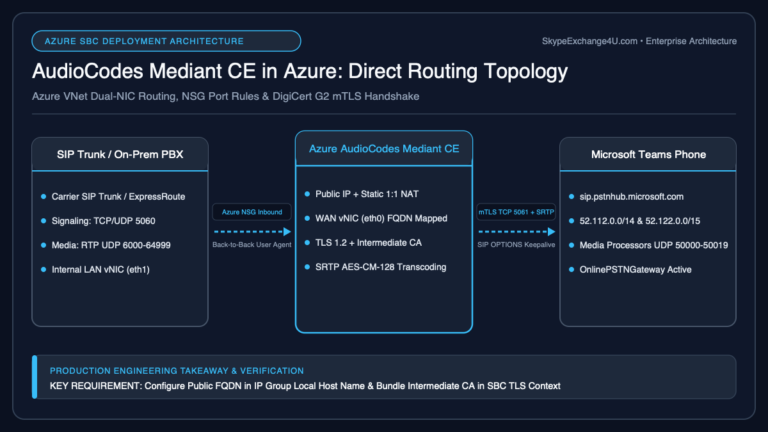
  • AudioCodes Mediant VE CE in Microsoft Azure Dual-NIC Teams Direct Routing Setup Architecture Diagram
    Teams & Enterprise Voice | Cloud & Azure | Latest Tutorials

    AudioCodes Mediant CE in Azure: Teams Direct Routing Setup Guide (2026)

    BySatya Pathak October 2, 2026October 20, 2026

    As enterprise IT departments decommission on-premises datacenters, voice infrastructure is rapidly shifting to the public cloud. Deploying an AudioCodes Mediant Cloud Edition (CE) Session Border Controller (SBC) inside Microsoft Azure provides a carrier-grade, highly available bridge between your SIP trunk providers, legacy PBXs, and Microsoft Teams Direct Routing without requiring physical datacenter rack space. However,…
    Read More AudioCodes Mediant CE in Azure: Teams Direct Routing Setup Guide (2026)Continue

  • Teams & Enterprise Voice

    Teams Phone Mobile (TPM) Architecture: IMS Integration, Native Cellular Dialing & Enterprise Deployment Guide

    BySatya Pathak October 2, 2026October 17, 2026

    As enterprise workforces shift permanently toward hybrid and mobile-first models, traditional desk phones are rapidly being decommissioned. While the Microsoft Teams mobile application has long allowed VoIP calling over cellular data (LTE/5G) and Wi-Fi, it has historically suffered from mobile OS battery throttling, incoming call delays, and dropped calls during network handoffs. Enter Teams Phone…

    Read More Teams Phone Mobile (TPM) Architecture: IMS Integration, Native Cellular Dialing & Enterprise Deployment GuideContinue

  • Teams & Enterprise Voice

    Microsoft Teams Auto Attendants & Call Queues: Setup & Routing Guide (2026)

    BySatya Pathak September 28, 2026October 20, 2026

    In enterprise voice deployments, an organization’s front-line telephony relies entirely on two core building blocks in Microsoft Teams Phone: Auto Attendants (AA) for automated interactive voice response (IVR) and directory navigation, and Call Queues (CQ) for intelligent call distribution across customer service, helpdesk, and sales teams. While Microsoft provides a graphical wizard in the Teams…

    Read More Microsoft Teams Auto Attendants & Call Queues: Setup & Routing Guide (2026)Continue

  • Teams & Enterprise Voice

    Teams Direct Routing Inactive After Certificate Renew (OPTIONS Fix)

    BySatya Pathak September 9, 2026October 20, 2026

    Microsoft Teams SBC Inactive After Certificate Renewal? How to Fix TLS and SIP OPTIONS Your SBC certificate was renewed, the certificate looks valid, but Microsoft Teams still shows the SBC as Inactive. Here is how to troubleshoot the problem without wasting time rebuilding your dial plans and voice routes. The Short Answer If a Microsoft…

    Read More Teams Direct Routing Inactive After Certificate Renew (OPTIONS Fix)Continue

  • Teams & Enterprise Voice

    AudioCodes vs Ribbon vs anynode: Best SBC for Teams Direct Routing

    BySatya Pathak September 4, 2026October 17, 2026

    Short answer: There is no single “best” SBC for Teams Direct Routing. AudioCodes, Ribbon, and anynode (TE-SYSTEMS) are all Microsoft-certified with media bypass and Local Media Optimization support. Pick by what you already run, who will support it at 2am, and whether you need appliance scale or a software-first footprint. Wrong fit shows up as…

    Read More AudioCodes vs Ribbon vs anynode: Best SBC for Teams Direct RoutingContinue

  • Teams & Enterprise Voice

    Hosted SBC Direct Routing Domain: Carrier Base, Customer Subdomain, Contact

    BySatya Pathak September 3, 2026October 17, 2026

    Short answer: A hosted SBC Direct Routing domain is the carrier base FQDN plus a unique customer subdomain under it (for example contoso.sbc1.carrier.com). You verify that subdomain in the customer tenant, activate it with a licensed user whose UPN uses that FQDN, put a wildcard cert on the SBC for the base, and send that…

    Read More Hosted SBC Direct Routing Domain: Carrier Base, Customer Subdomain, ContactContinue

  • Teams & Enterprise Voice

    Teams Direct Routing 488 Not Acceptable Here: SDP, Codecs, SRTP

    BySatya Pathak September 2, 2026October 14, 2026

    Short answer: A 488 Not Acceptable Here response in Microsoft Teams Direct Routing usually means that the SIP session or media negotiation cannot be accepted. The cause can involve the SDP offer, supported codecs, SRTP, ICE/media bypass, SBC configuration, or the carrier side. The important part is not to treat every 488 as the same…

    Read More Teams Direct Routing 488 Not Acceptable Here: SDP, Codecs, SRTPContinue

  • Teams & Enterprise Voice

    Media Bypass vs Local Media Optimization: When Teams Skips the SBC

    BySatya Pathak September 1, 2026October 20, 2026

    In Microsoft Teams Direct Routing, SIP signaling always routes through Microsoft’s cloud infrastructure (sip.pstnhub.microsoft.com). However, routing the actual voice audio—the Real-time Transport Protocol (RTP/SRTP) media stream—through the cloud is often inefficient, introduces latency, and consumes unnecessary internet bandwidth. To eliminate audio trombone effects (where two employees in the same building have their audio routed through…

    Read More Media Bypass vs Local Media Optimization: When Teams Skips the SBCContinue

  • Teams & Enterprise Voice

    Teams Dial Plan vs Voice Routing Policy: Normalization Is Not Routing

    BySatya Pathak August 29, 2026August 29, 2026

    Short answer: The usual mix-up is Teams dial plan vs voice routing policy. A dial plan only changes the digits into a standard form, usually E.164. A voice routing policy does not rewrite digits. It lists PSTN usages, those usages point at voice routes, and the route’s number pattern (matched after normalization) selects the SBC….

    Read More Teams Dial Plan vs Voice Routing Policy: Normalization Is Not RoutingContinue

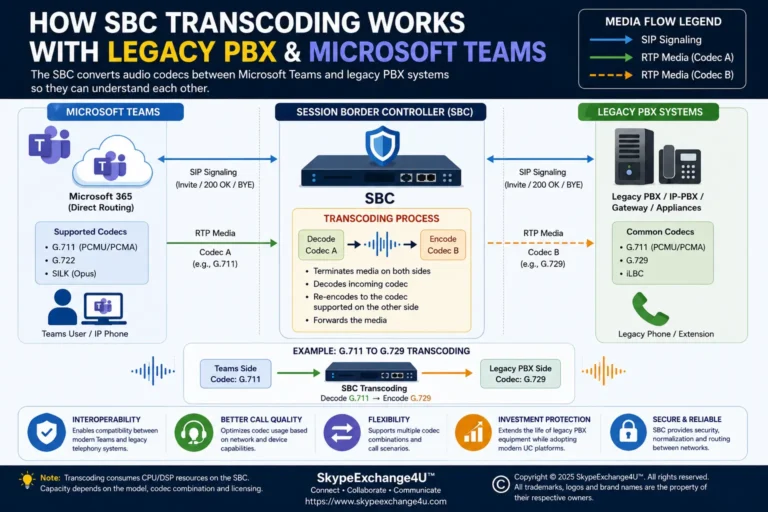
  • SBC transcoding between Microsoft Teams and a legacy PBX using different audio codecs
    Teams & Enterprise Voice

    SBC Transcoding with Microsoft Teams & Legacy PBX

    BySatya Pathak August 26, 2026October 20, 2026

    ENTERPRISE VOICE • SBC • MICROSOFT TEAMS™ How SBC Transcoding Works with Legacy PBX Systems and Microsoft Teams A practical, vendor-neutral guide to codec negotiation, media transcoding, Direct Routing, legacy PBX integration, configuration strategy and troubleshooting. Updated: August 2026 • Reading time: 12–15 minutes ⚡ Short answer: An SBC (Session Border Controller) can perform media…

    Read More SBC Transcoding with Microsoft Teams & Legacy PBXContinue

Page navigation

1 2 Next PageNext
SkypeExchange4U — Microsoft 365 & Enterprise Voice Logo

What is SkypeExchange4U? SkypeExchange4U is an independent engineering resource by Satya Pathak providing practical, production-tested runbooks for Microsoft Teams Direct Routing, Session Border Controllers (SBCs), Entra ID identity sync, and hybrid voice architecture.

Explore

Microsoft 365
Cloud & Azure
Teams Voice
Active Directory
☁️ CloudTrim (M365 & Azure FinOps) ↗
⚡ Free Speed & SEO Audit

Facebook X Instagram

© 2026 SkypeExchange4U — SkypeExchange4U is an independent Microsoft 365 and enterprise-voice blog by Satya Pathak. Not affiliated with Microsoft, Skype, or SkyExchange.

  • About Us
  • Contact Us
  • Privacy Policy
  • Disclaimer
  • Terms and Conditions
Scroll to top
  • Teams Voice
  • Microsoft 365
  • Active Directory
  • Cloud
  • ⚡ FinOps Tool
  • About
  • Contact
  • Terms and Conditions
Search