
Skip to content
SkypeExchange4U
  • Teams Voice
  • Microsoft 365
  • Active Directory
  • Cloud
  • About
  • Contact
  • Terms and Conditions

SkypeExchange4U

Teams Direct Routing, SBC, and hybrid identity guides

Practical Microsoft Teams voice and Entra ID notes from real deployments. Call flow, SBC setup, and troubleshooting. No fluff.

SkypeExchange4U

SkypeExchange4U

Teams Direct Routing, SBC, and hybrid identity guides

Practical Microsoft Teams voice and Entra ID notes from real deployments. Call flow, SBC setup, and troubleshooting. No fluff.

  • Teams & Enterprise Voice | Latest Tutorials

    Teams Direct Routing Local Media Optimization (LMO): Central & Proxy SBC Architecture Runbook

    BySatya Pathak October 4, 2026October 6, 2026

    Enterprise Voice Engineering Runbook In multi-site Microsoft Teams Direct Routing deployments, routing media traffic across the internet to Microsoft cloud Transport Relays introduces latency, jitter, and excessive WAN bandwidth consumption. Local Media Optimization (LMO) solves this by keeping voice media local to corporate subnets while centralizing SIP signaling through a parent Central SBC connected to…
    Read More Teams Direct Routing Local Media Optimization (LMO): Central & Proxy SBC Architecture RunbookContinue

  • Teams & Enterprise Voice

    SIP 486 Busy Here & 603 Decline in Teams Direct Routing: Call Forwarding Loops, Busy Options & Carrier Fixes

    BySatya Pathak September 29, 2026September 29, 2026

    In SIP telephony and Microsoft Teams Direct Routing, handling an unanswered or rejected call requires precise signaling between the Microsoft Teams SIP Proxy, your Session Border Controller (SBC), and the PSTN carrier. Two response codes are frequently misunderstood by voice engineers: SIP 486 Busy Here and SIP 603 Decline. While both indicate that a call…

    Read More SIP 486 Busy Here & 603 Decline in Teams Direct Routing: Call Forwarding Loops, Busy Options & Carrier FixesContinue

  • Teams & Enterprise Voice

    SIP 487 Request Terminated & 408 Request Timeout in Teams Direct Routing: NAT Timeouts, Carrier Ring Timers, and Firewall Deep-Dive

    BySatya Pathak September 27, 2026September 27, 2026

    When analyzing VoIP traces in an enterprise Microsoft Teams Direct Routing deployment, two SIP response codes frequently cause confusion among voice engineers: SIP 487 Request Terminated and SIP 408 Request Timeout. While a SIP 487 is often completely benign—representing normal call abandonment by the calling party or an unanswered call forwarding to voicemail—it can also…

    Read More SIP 487 Request Terminated & 408 Request Timeout in Teams Direct Routing: NAT Timeouts, Carrier Ring Timers, and Firewall Deep-DiveContinue

  • Teams & Enterprise Voice

    Teams Dynamic Emergency Calling (E911): Complete RAY BAUM’S Act & Kari’s Law Guide

    BySatya Pathak September 26, 2026September 26, 2026

    In enterprise cloud voice, emergency calling is not just another routing feature—it is a strict federal legal mandate backed by heavy FCC fines and civil liability. In the United States, two federal laws govern every enterprise telephony deployment: Kari’s Law: Requires direct 911 dialing without any trunk access code (no dialing 9 for an outside…

    Read More Teams Dynamic Emergency Calling (E911): Complete RAY BAUM’S Act & Kari’s Law GuideContinue

  • Teams & Enterprise Voice

    Ribbon SBC 1000/2000 Configuration for Teams Direct Routing: Step-by-Step Guide

    BySatya Pathak September 25, 2026September 26, 2026

    Along with AudioCodes, Ribbon Communications (formerly Sonus Networks) represents the gold standard in certified enterprise Session Border Controllers for Microsoft Teams Direct Routing. Whether deploying an appliance-based Ribbon SBC 1000 or SBC 2000 or a virtualized Ribbon SBC SWe Lite (in Azure, AWS, VMware, or Hyper-V), setting up Direct Routing requires strict adherence to Microsoft’s…

    Read More Ribbon SBC 1000/2000 Configuration for Teams Direct Routing: Step-by-Step GuideContinue

  • Teams & Enterprise Voice

    Deploying Teams Survivable Branch Appliance (SBA): Offline Calling Architecture

    BySatya Pathak September 25, 2026September 25, 2026

    When an enterprise migrates voice services to the cloud, the single biggest operational fear for hospital campuses, financial institutions, and manufacturing plants is a complete WAN or internet blackout. If an excavator tears through a fiber line, cloud-hosted telephony dies—taking critical emergency calling and internal communications with it. The Microsoft Teams Survivable Branch Appliance (SBA)…

    Read More Deploying Teams Survivable Branch Appliance (SBA): Offline Calling ArchitectureContinue

  • Teams & Enterprise Voice

    Teams Direct Routing SIP 403 Forbidden: Fixing Regex, PSTN Usage & SBC FQDN Mismatches

    BySatya Pathak September 25, 2026September 25, 2026

    When Microsoft Teams Direct Routing throws a SIP 403 Forbidden, call setup is dead on arrival. Unlike a 503 error—which triggers route failover—a 403 is a hard rejection. The server is telling you: “I received your INVITE, I understood it, and I refuse to process it.” In production enterprise voice deployments, 403 errors split into…

    Read More Teams Direct Routing SIP 403 Forbidden: Fixing Regex, PSTN Usage & SBC FQDN MismatchesContinue

  • Teams & Enterprise Voice

    Teams Direct Routing SIP 503 Service Unavailable: Troubleshooting SBC & Trunk Outages

    BySatya Pathak September 24, 2026September 24, 2026

    Short answer: A SIP 503 Service Unavailable error in Microsoft Teams Direct Routing indicates that a component in the call path—either the Microsoft SIP proxy, your Session Border Controller (SBC), or the upstream PSTN carrier—is temporarily unable to process the call. The most common causes are failed SIP OPTIONS heartbeats, TLS certificate issues, carrier trunk…

    Read More Teams Direct Routing SIP 503 Service Unavailable: Troubleshooting SBC & Trunk OutagesContinue

  • Teams & Enterprise Voice

    Microsoft Teams Direct Routing Sbc Configuration — Complete Step-by-Step Guide (Tested for 2026)

    BySatya Pathak August 31, 2026September 26, 2026

    Why Microsoft Teams Direct Routing Sbc Configuration Early Saves Hours of Downtime SKYPEEXCHANGE4U™ | TEAMS PHONE Microsoft Teams Direct Routing with SBC: From Tenant Setup to First Call A practical guide to connecting Microsoft Teams™ Phone with an SBC, existing PBX or PSTN infrastructure — from the first DNS record to your first successful call….

    Read More Microsoft Teams Direct Routing Sbc Configuration — Complete Step-by-Step Guide (Tested for 2026)Continue

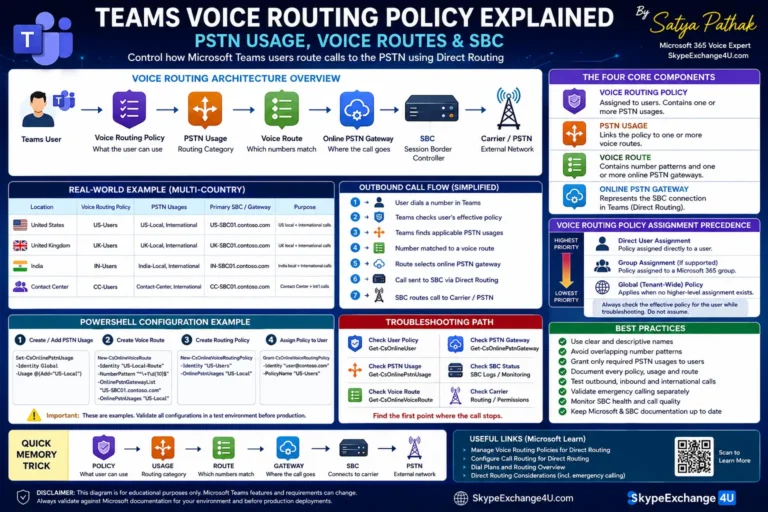
  • Microsoft Teams Voice Routing Policy showing PSTN usage voice route and SBC call flow
    Teams & Enterprise Voice

    Teams Voice Routing Policy Explained: PSTN Usage, Routes & SBC

    BySatya Pathak August 26, 2026October 9, 2026

    Teams Voice Routing Policy Explained: PSTN Usage, Voice Routes & SBC Short answer: A Microsoft Teams Voice Routing Policy determines which PSTN usages are available to a user. Those PSTN usages connect the user to voice routes, which contain number patterns and PSTN gateways. In a Direct Routing deployment, the selected gateway normally represents the…

    Read More Teams Voice Routing Policy Explained: PSTN Usage, Routes & SBCContinue

Page navigation

1 2 Next PageNext
SkypeExchange4U — Microsoft 365 & Enterprise Voice Logo

What is SkypeExchange4U? SkypeExchange4U is an independent engineering resource by Satya Pathak providing practical, production-tested runbooks for Microsoft Teams Direct Routing, Session Border Controllers (SBCs), Entra ID identity sync, and hybrid voice architecture.

Explore

Microsoft 365
Cloud & Azure
Teams Voice
Active Directory
⚡ Free Speed & SEO Audit

Teams Direct Routing, SBC & Entra ID Guides | SkypeExchange4U

Facebook X Instagram

© 2026 SkypeExchange4U — SkypeExchange4U is an independent Microsoft 365 and enterprise-voice blog by Satya Pathak. Not affiliated with Microsoft, Skype, or SkyExchange.

  • About Us
  • Contact Us
  • Privacy Policy
  • Disclaimer
  • Terms and Conditions
Scroll to top
  • Teams Voice
  • Microsoft 365
  • Active Directory
  • Cloud
  • About
  • Contact
  • Terms and Conditions
Search